In a previous post I wrote about how telling a story provides the framework for a scientific talk. As human beings, we are naturally wired to organize our world in narratives. Thus the power of storytelling is two fold. First, stories are much easier to tell than going through a series of disconnected facts and observations. Second, stories are much easier for the audience to absorb. Win win.
Ok great. But how does one get started constructing the story?
Storyboarding – the visual representation of a story or presentation- originated in the early 20th century in the animation industry. These early storyboards were simple, hand-drawn sketches that showed the key frames and actions of the animation. In the 1920s and 1930s, storyboarding became a standard practice in the film industry. Not long after, the practice expanded to other fields including advertising and architecture where plans and concepts had to be translated to visual form.
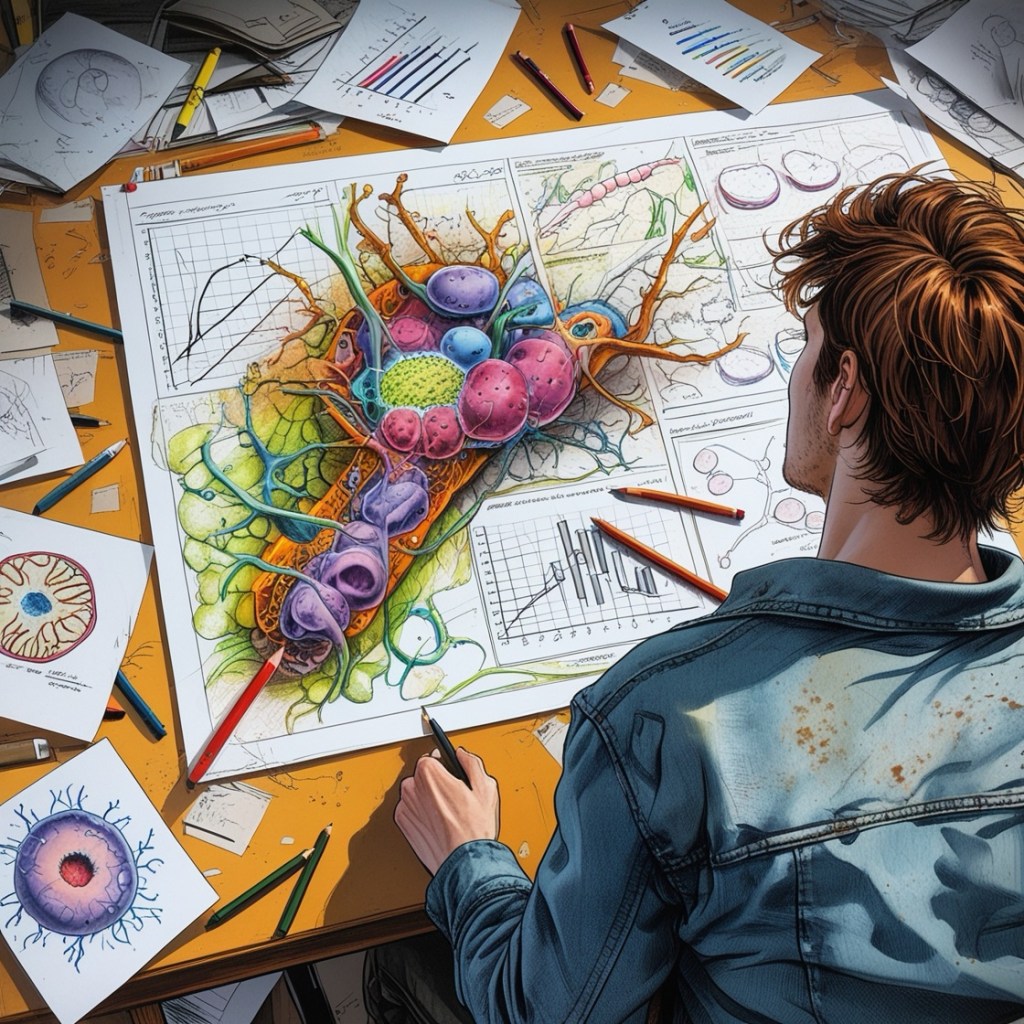
I would like to suggest that storyboarding can also be useful when constructing scientific talks – not for figuring out camera angles or set design – but for mapping out the story arc of the talk in visual form. While delivering a talk should be mostly about what you say, slides play a critical supporting role. Storyboarding can also help to ensure that slides match the story narrative.
The simplest form of storyboarding would consist of a stack of cards or sheets of paper. More sophisticated electronic software can also be used but I personally prefer pen on paper.
The best place to start is with a rough outline of the talk – and here, the story structure can start to take shape. The strategy is to map out the main elements of the narrative – especially the most surprising result in your investigation. That most surprising result should be the pinnacle of your story narrative – where previous assumptions all change and a new way of thinking emerges.
The introduction would outline the nature of the problem being discussed, enough background for the audience to understand the problem and the ‘hook’, that emotional open that grabs the audience’s attention. Next? A hypothetical model potentially explaining the phenomenon – preferably in visual form along with a mechanistic hypothesis.
The stage is now set to unveil the strategy for addressing the problem. Your team, key reagents, samples to be tested, methods, equipment, followed by a description of the experiments you performed and the data that you collected. All leading to your interpretation of the results and how it changed your understanding of the problem. The denouement is where additional approaches to further testing and refining your model of the phenomenon are explained.
A longer talk can contain many such stories, but it is important that they all be linked in a coherent narrative.
Once the main elements are assembled, the details can now be added. Images, schematic models, BioRender-type figures, data. And then finally, these elements can be used to create slides that are designed to help the narrative move along, not replace it.
I would love to hear your take on how you prepare your talks. Do you use a storyboarding approach? Another strategy? Please comment, like, repost here or at my LinkedIn page. And if you think I can help you in getting your message out, please contact me directly here or at LinkedIn for assistance.
 StuartABerger.com
Leave a comment